How difficult is it to check if you have a bald spot in the middle of your hair? Sure, you can have a feel around and try to identify some missing hair on the top of your head, but to do a visual test is difficult.
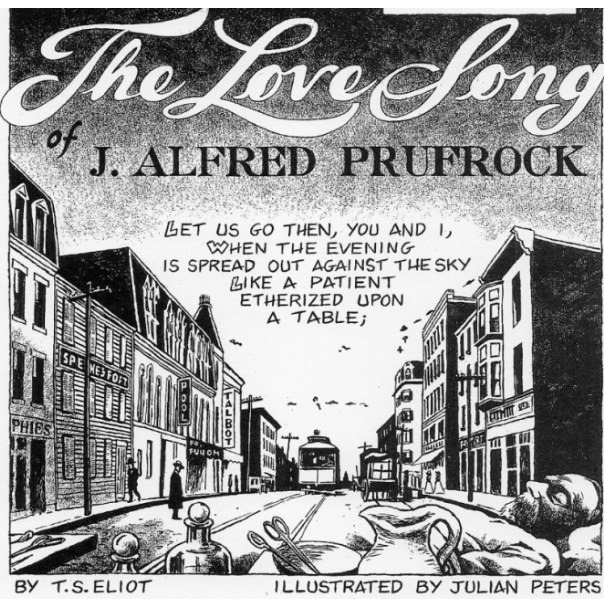
Prufrock was doing just that as we home in on his life. He had learnt that by using only the bathroom mirror it was impossible to do the visual check, as you had to drop your eyes down to enable the mirror to pick up the location of the potential hair void. And if you turned around to show the mirror the area in question, your eyes would be facing the wrong way to see anything.
Now manipulating two small mirrors – one at the back of his head and one in front of him – Prufrock ingeniously (his view) confirmed the murmurs, then mutters: “How his hair is growing thin!”
He sat back dejected. This just added to his funk. Was it mid-life crisis? Was it the onset of depression?
Slumped in the chair he tried to psychoanalyse his feelings. His childhood was rather nondescript. Nothing really there to help explain it, he thought. However, he did feel he had to live in his father’s footsteps – at least, his name. See his father – originally named ‘John Brown’ – had searched for his own identity. May be the malady is hereditary, Prufrock mused.
Father had fallen in love with T.S. Eliot (the famous American poet, long before deceased). He then had some Eliot-driven epiphany involving leaving mother, and him doing several degrees in literature (majoring in the poetry of Eliot) and becoming an Associate Professor of Eliot (sorry, Literature specialising in Eliot) at some obscure overseas university.
Father was so smitten with Eliot that he’d long ago changed his name by deed poll to ‘J. Alfred Prufrock’ – a character in an Eliot poem who was searching for himself. And to make matters worse, just prior to father’s departure, and through some weakened state of mind (e.g. wild sex, drunken stupor), mother had supported the naming of the newly-born child as ‘J. Alfred Prufrock Jnr’.
Mmm, my name could be a factor in my malcontent, the younger Prufrock pondered.
And this given name had been a cross to bear. With literally no father (albeit having a literary father), Prufrock discarded the ‘Jnr’ as soon as he could by deed poll. He had heard that ‘Alfred’ was a relatively common second name (this author’s middle name is Alfred), and not wanting to expand the ‘J.’ (which had to be ‘John’ as per his father’s former name), he thought he would replace ‘Alfred’ with the exotic ‘Rodolfo’ to spice up his image through the juxtaposition of Spanish with Anglo-Saxon words. It might attract some woman (Julio and Enrique Iglesias were big attractions to English-speaking ladies!).
To make matters worse, in his country the use of the nickname was rife. Like a pagan ritual, all males would receive at least one ‘other’ name (some that could not be repeated in this story) in their youth. However, most nicknames were reasonably unimaginative e.g. Daniel = ‘Danno’, Johnson = ‘Johnno’, Smith = ‘Smithy’. There were some more lateral thinkers though, and Prufrock was affectionately dubbed by one: ‘The Skirt’ – derived from the latter syllable of his surname. The name stuck and introductions to ladies went like this: ‘I’m Danno, this is Johnno, this is Smithy and over there is The Skirt’ (he wished they’d call him ‘Rodolfo’). This didn’t help his woman-chasing cause.
So here he was in his thirties, living at home with mother, with a weird-sounding name, an effeminate nickname and without a woman (or even a date). He felt he was going nowhere, like he was wedged in a vice between his past (youth) and his future (old age – ‘shall I wear the bottoms of my trousers rolled?’). Thirties was supposed to be fun according to the ‘Friends’ show on TV. Sometimes he wished he would be a pair of ragged claws scuttling across the floors of silent seas (oops, was that a quote from Eliot?).
It was now time for him to act – for decisions, visions and revisions. Break out of the melancholy. He made a list of improvements:
I will be assertive in using my new (real) name; no, it is not ‘The Skirt’, it is ‘Rodolfo’ ladies.
I will get a bachelor pad. Goodbye, mother.
I will forget my past. Goodbye, father
I will get a hair transplant.
But how to actually woo a woman? He had had numerous opportunities – nightclubs, bars; he’d tried them all but to no avail. The result was nil. They didn’t care about a flash name or full head (almost) of hair. They seemed preoccupied. In the room the women come and go talking of Michelangelo (another Eliot-ism, well they talked about something, but not him).
So, he tried online dating. He had posted his profile using a grainy photograph (not too much detail – woman can air brush theirs), highlighted his saucy name in bold and tried to lift his unremarkable past through some imaginative description. And he did get one email reply. Excited he replied. I’ll text you, she said. Sure, he said.
She: OMG u Rodolfo?
He: certainly, Rodolfo is my name. What are you doing?
She: JC
He: what?
She: YSAN
He: what are you saying?
She: 4COL
He: For Col, I’m not Col!
She: LOL @ u
He: LOL oh, you mean Lots of Love. Do you love me already?
She: WTF Go Away!
That love-text didn’t seem to work out. He stood up, emboldened.
He wanted to feel secure in the warm womb of the train.
He was a long distance commuter: one of that hardened breed that criss-crossed the city every day. One of the many who sat in cars, buses, trains, trucks, trams, ferries etc. for hours; ‘downtime’ they called it. For what? Work = Money = A Lifestyle Back Home.
These were the ones that saw little sunlight: up before dawn, back home after sundown; urban troglodytes living in a work/commute cavern only really seeing the sun on days off. And without sunlight, and quarantined by the commute, they existed in a fugue state; hazed, dazed eunuchs neutered by routine; metronomes swinging to the money tune.
And their cityscape – when it could be seen – offered little respite, the backblocks a wasteland of factories, weathered infrastructure and decaying suburbs. A rusting, unplanned urban mess.
For the commute he had opted for the train long ago. The car was dear to run; the expressways were scary. And buses, ferries, trams were out of the mix of options – they didn’t go his way.
Each morning, he would rush down to the station to jostle for a position to be first on the train, in the same carriage, in the same seat. And do the same on the return journey. Every working day. If this all worked to plan, and the trains ran on time, it would be a ‘good train day’; if things didn’t work to plan, he felt dishevelled, out of kilter i.e. ‘a bad train day’.
The train controlled his moods.
But unlike most of his colleagues-on-the-train, he had train insomnia. The others slept in the morning, slept at night. And he, he couldn’t sleep, not even a wink. You would think the repetitive clickety-clackety of the moving train coupled with its gentle sideways rocking would be soporific, as sleep-inducing as being rocked in a cradle. But no, he was wide awake.
And what do you do if you can’t sleep for hours in a train carriage? You could:
read
eat
do a brain-teaser
do something techno
twiddle your thumbs
do nothing
gaze out the window at nothing
watch others
He opted for the last on the list. ‘Trainspotting’ he called it.
They were creatures of habit these habitual ‘trainers’, sitting in the same seat, going through the same rituals. However, when not sleeping agape like clowns in a sideshow or snoring like grunting pigs, they showed glimpses of personality. He enjoyed watching them.
Always in the front seat on the left-hand side was ‘The Wizard’ (he had a name for all the regulars in his second last carriage). The Wizard, when not asleep, would conjure up a way to draw some newcomer into a conversation around a pet topic. The magic was in the method. For example:
Wiz: Nice day?
Newcomer (NC): Some rain is forecast
Wiz: Rain? Did you ever see that movie ‘Singing in the Rain’?
NC: I don’t watch many movies, but I thought I saw it many years ago
Wiz: Oh, you talk about movies. Have you seen the one I’m watching at the moment called ‘Vampirelicious’?
NC: No, but it sounds…well, interesting
Wiz: Let me tell you about it and vampires…
Another newcomer was under The Wizard’s spell of vacuous verbiage! Canny Wizard, he thought.
And there were others he watched that succoured his interest. In the second back row on the right hand side was ‘Mister Trivia’. Trivia was behind his own seat (which was on the window on the left in the sixth row from the front), but he could always hear Trivia. When not snoring, Trivia would, extremely loudly, conduct a phone conversation with another quiz buff that involved practising the answers to possible trivia night questions (how many possible questions could there be? he thought). For example, Trivia might call out ‘What is the capital of Botswana?’ ‘Is it a. London? b. Gaborone? c. Guatemala City?’ And a discussion around the correct answer ensued, and then more questions/options/answers, broadcast to all that were awake. All trivial pursuits, he thought.
And across from him always was ‘The Lady’. For most of the journey Lady slept cocooned in a blanket, probably dreaming of walking down a Paris catwalk in some exotic gown. For The Lady liked glamour, or pretensions to glamour. An automatic alarm would then ring in her brain with fifteen minutes to go on the journey. She would spend this remaining time pimping, preening, prodding her face, pasting on mascara, blush, eyeliner and whatever else glamour-inducing that was in her makeup bag. He thought of Eliot’s line: ‘to prepare a face to meet the faces that you meet’.
He could accept these same behaviours from these same people.
But rapid change came to the train. The Wizard was now only an infrequent passenger (may be Wizard had a new job in marketing, he thought). Mister Trivia was nowhere to be heard (may be now a game show host?) and The Lady, although still a regular, no longer put on a face but went au naturel (had she found a fellow or religion?). And many of the other ‘names’ changed in some disturbing way. Maybe it was the financial crisis? Or some type of pandemic? Or a drop in petrol prices?
To add to his resultant voyeuristic angst, newcomers were invading the carriage. These newcomers were either ‘one-timers’ or those that didn’t care what carriage or seat they sat in. And their irritative behaviours:
Chip-crunching
Apple-munching
Mobile phone-arguing
Baby-screaming
Nose-snuffling
Lolly-sucking
And, worst of all, newspaper-scrunching.
These were not minor disturbances; collectively, to him they were major geological upheavals to the stability of the train: tremors that shook his world. ‘Bad train days’ now far outnumbered ‘good train days’.
But what could he do? He loved the train – when it was the same, ordered. And the non-train options were out of the question. So wracked by anxiety he pondered his train future: how to embrace his love of train routine and control the irregularities.
And then it came to him – he would give his life to train.
Several months later, it was time. It would only take one step. He nervously glanced around at the surrounding passengers. What would they think when he did it? Would they respond? Beads of perspiration dripped off his brow. And summoning all his inner strength, he stepped…off on the platform and commenced his first day as a trainee train guard.







 Neil Dufty's stories and poems